In design texture can be both physical and virtual. It can be the physical surface or the optical appearance of that surface. Most designs are smooth, and the viewer doesn’t have the opportunity for feeling rough surfaces. I think most texture in design is visual where the piece just looks like it would feel a certain way. I think the examples in the book of texture through text is beautiful. Rough, fuzzy, bumpy. Text can create texture through color, stroke width, letterspacing, and paragraph leading.
Color can convey a mood. Happy, drab, glittering, mysterious. Color can connect items, differentiate items, highlight or hide items by using colors to make them stand out or disappear through camouflage. There is so much information with color. Color is used for everything and there are so many combinations and different hues, intensity, and saturation to create so many things. I love color! I feel like most designs now a days stick to a one-3 color scheme. Especially with logos, I feel like they are all so boring and plain. I would love to see more logos use more colors rather than just blue, or just green, or just red. I know it helps with branding and cost efficiency, but its just so boring! Also I still don’t understand Pantones and when and how to change them. That makes no sense to me.
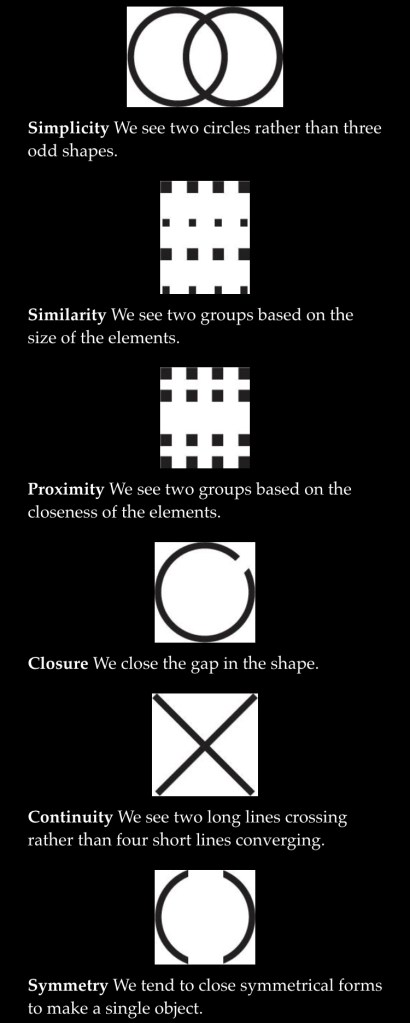
Gestalt Principles: “All things interact with other things.” Our brains like to build a coherent understanding of he works. So we like to simplify, categorize, and break down information that is coherent and understanding. So to make it easier for the viewer, designers separate forms from the space, color, or patterns that surround them to make visuals more comprehensible. Grouping also helps us to breakdown and categorize an image. Different types of grouping are simplicity, similarity, proximity, closure, continuity, and symmetry.
 Fundamentals of Communication Design